
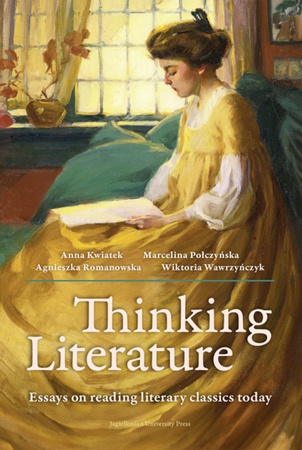
Thinking Literature
- Inspired by Mary Shelley’s conviction that reading is a socially significant communal activity, Thinking Literature. Essays on Reading Literary Classics Today is a collection of four essays whose authors discuss modern interactions wit...
Inspired by Mary Shelley’s conviction that reading is a socially significant communal activity, Thinking Literature. Essays on Reading Literary Classics Today is a collection of four essays whose authors discuss modern interactions with literary classics. Antigone by Sophocles, Shakespeare’s Hamlet, Romeo and Juliet and The Tempest, and Mary Shelley’s Frankenstein are read anew via their modern retellings and applied to the challenges and dangers of the contemporary world. The titular phrase, thinking literature, is meant to indicate reading literature of the previous epochs in a way that allows one to contemplate human condition against the background of the past and in connection with the present. Thinking literature as practised by rewriters, adaptors and interpreters is then shared with readers, creating the sense of dialogue without which the communal aspect of reading would not be fulfilled.
The book begins with a short preface explaining the collection’s origin. In the first chapter Marcelina Połczyńska discusses Kamila Shamsie’s novel Home Fire, a contemporary retelling of Antigone by Sophocles, which transplants the ancient conflict over burial rights and the legitimacy of law to the community of British Muslims in contemporary London. The second essay, by Wiktoria Wawrzyńczyk, examines Ahmed Saadawi's Frankenstein in Baghdad. Focusing on fragmentation as the novel’s key device, the author observes that the social commitment of Saadawi’s novel is not limited to the immediate context of the novel’s setting, but pertains to a number of acute problems and crises we are facing nowadays on a global scale. The third chapter deals with the issue of suicide in Shakespeare’s plays, one of the themes nowadays seen as potentially harmful to vulnerable audiences. Anna Kwiatek analyses Romeo and Juliet and Hamlet in order to inspect the concerns voiced against Shakespeare allegedly romanticising suicidal death in his plays. Her essay confirms the unceasing topicality of the discussion on how the reception of an author so ubiquitously present in education and theatre as Shakespeare is shaped by changing sensitivities and concerns. In the last chapter Margaret Atwood’s novel Hag-Seed, a retelling of The Tempest, is discussed as an extended meta-artistic game played with Shakespeare. Agnieszka Romanowska analyses Atwood’s imaginative and multifaceted dialogue with Shakespeare’s play to argue that it takes the form of a dense and intricate web of meta-artistic interactions performed on various levels of the novel.
The book’s key feature is its direct link with how literature is read, taught and imaginatively exploited in culture. The four essays testify to the lasting relevance of works of literature created in previous epochs, to the significance of their cultural legacy and the impressive scope of their impact. The contemporary interactions with ancient Greek tragedy, Shakespeare and Frankenstein discussed here are examples of reading as a communal activity, as understood and advocated by Mary Shelley. Thinking literature by revisiting canonical texts and sharing with others the experience this brings, helps us to define, understand and confront the social and political challenges of today’s increasingly complex world. Therefore the collection will be equally interesting to students of literature, to those who teach literature on university level, and to readers of literature in general, especially those interested in adaptation of literary classics.